Why Your Child’s Career Counselor May Not Understand the Job Market
Picture a student sitting across from her college career counselor. She’s done everything she was told to do: kept her GPA up, joined a few clubs, and gone to the career fair. Now she has real questions. What actually happens after the interview? Does the name of her school matter as much as she fears? Will her internship at a small, unknown company count for anything with a bigger employer?
The counselor is kind and wants to help. But she often can’t answer those questions, and it’s not her fault. Most career counselors are trained in student development, counseling, and academic policy. They know degree requirements, transfer credits, and graduation timelines inside and out. What many of them don’t have is direct, current experience with how employers actually hire.
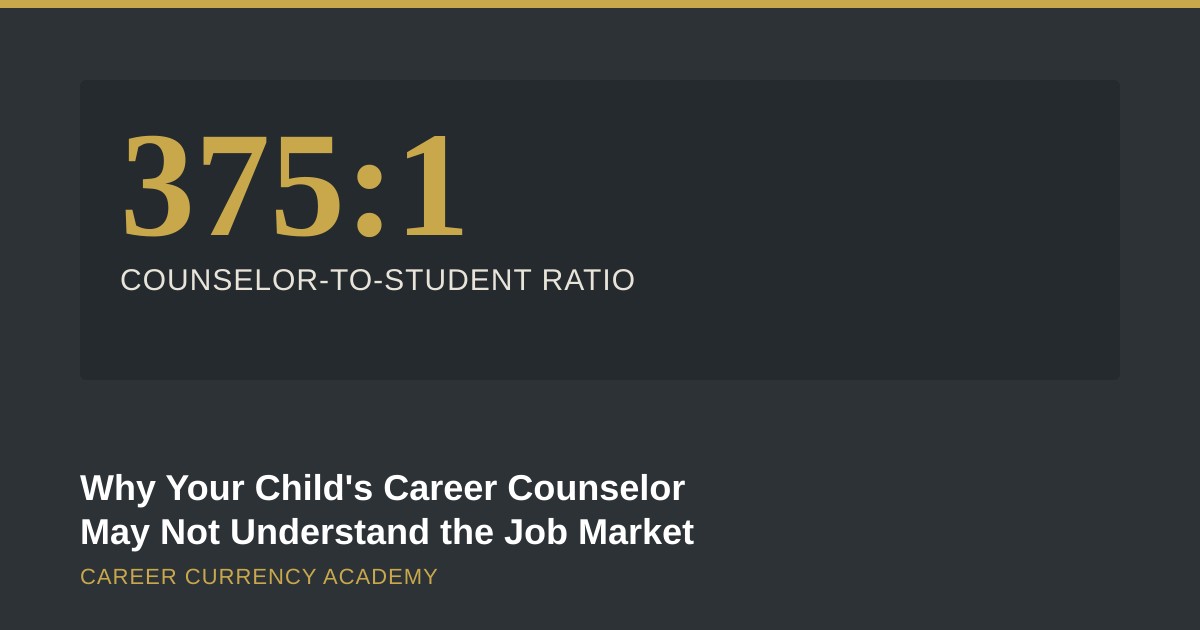
Those are two different skill sets. Academic fluency is knowing how the college works. Labor market fluency is knowing how hiring works: how recruiting cycles run, how industries differ, how a candidate actually stands out when two resumes look almost the same. Colleges have spent decades building the first. Most haven’t built the second, and the average counselor is stretched across roughly 375 students, which leaves little room to develop it even for those who want to.
The cost shows up quietly. A student asks which industries are hiring for her major and gets pointed to a job board. A student asks whether a company recruits on campus and nobody knows. When the honest answer is “I’m not sure,” students rarely conclude the system let them down. They conclude they should have already figured it out themselves.
It matters because the stakes are real. Research from the Burning Glass Institute found that 73% of graduates who start out underemployed are still underemployed 10 years later. Vague advice at the moment a student is making one of the biggest decisions of their life doesn’t just cost a few frustrating months. It can shape a decade.
This is exactly the gap Career Currency Academy was built to close. It’s not run by career counselors. It’s run by people who’ve spent their careers hiring, managing, and working directly inside companies, teaching students the parts of getting hired that a campus office was never designed to teach: how employers actually decide, how to build real professional relationships, and how to walk into that first job instead of guessing at it.
Career Currency Academy teaches students what campus career offices often can’t: how hiring actually works, from people who’ve done the hiring.
See the Full System