Six Billion Friendships Later, the Answer Is the Same
When Harvard’s research on friendship and economic mobility came out, the obvious question was whether it was an American quirk. So a UK consortium including the Behavioural Insights Team ran the same analysis on six billion friendships covering about 20 million UK adults.
Same answer.
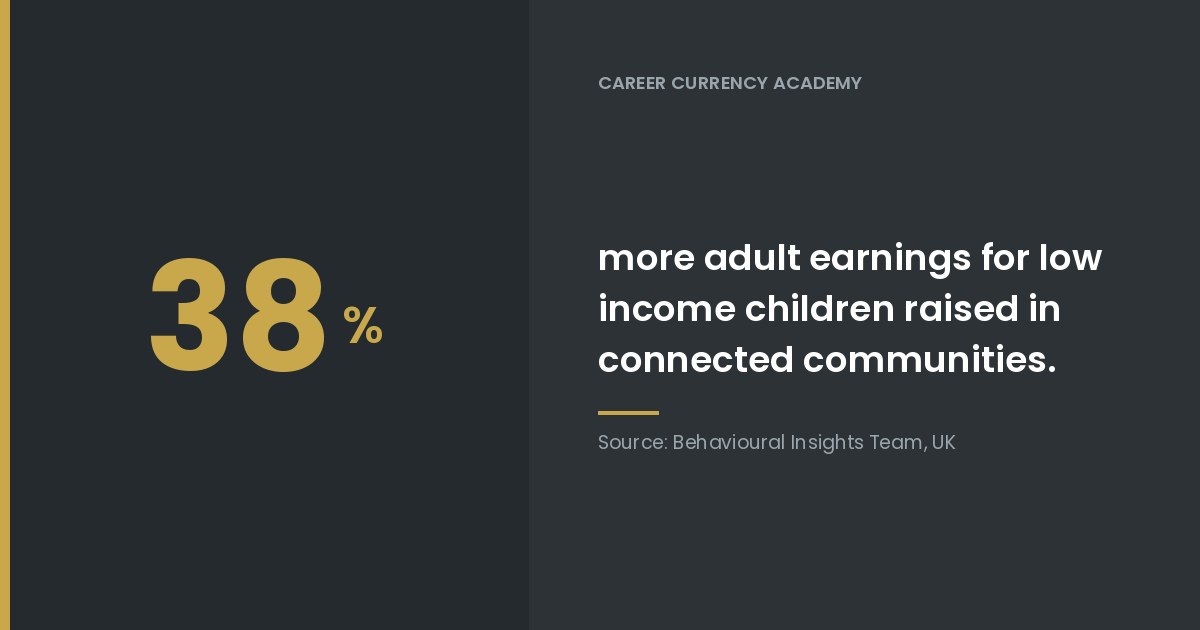
Children from lower-income families who grew up in the most economically connected local areas earn 38% more as adults than similar children from the least connected areas. That works out to roughly 5,100 pounds a year. After median income, economic connectedness was the strongest independent predictor of upward mobility in an area, and it held up even after controlling for education and health outcomes.
There was a second finding that got less attention and probably deserves more. People with more high-income friends and tighter social circles reported higher happiness, higher trust, and less isolation. So the same thing that predicts earnings also predicts wellbeing, which is worth saying out loud to any parent who feels a bit queasy about treating friendship as a career strategy.
Nobody is suggesting your student audit their friends by income bracket. That would be both gross and ineffective, and teenagers can smell it coming a mile off.
What the research actually supports is simpler. Environments where different kinds of people mix produce better outcomes for the people who had less to start with. And the study was specific about where those cross-class friendships form: workplaces and hobby groups, while neighborhoods and schools tend to stay segregated.
So encourage the part-time job. Encourage the club that isn’t full of people exactly like your student. Those two settings are doing more work than they look like they’re doing.
Two countries, different data, same conclusion. Who your student knows isn’t a soft factor.
Career Currency Academy teaches students to build connections on purpose, not by luck of address.
See the Full System