Your Student’s First Job Matters More Than Their Major
Researchers at Columbia and the National Bureau of Economic Research tracked 80,000 graduates from a large public university system. They wanted to know why low-income graduates earn less than higher-income graduates years after they leave with the same degrees.
The answer was almost entirely the first job.
Features of that first job (the employer’s size, its average pay, the industry, the starting salary) explained nearly two-thirds of the earnings gap five years out. Even among students with the same GPA, the same major, and the same college, a gap of about 4,900 dollars persisted.
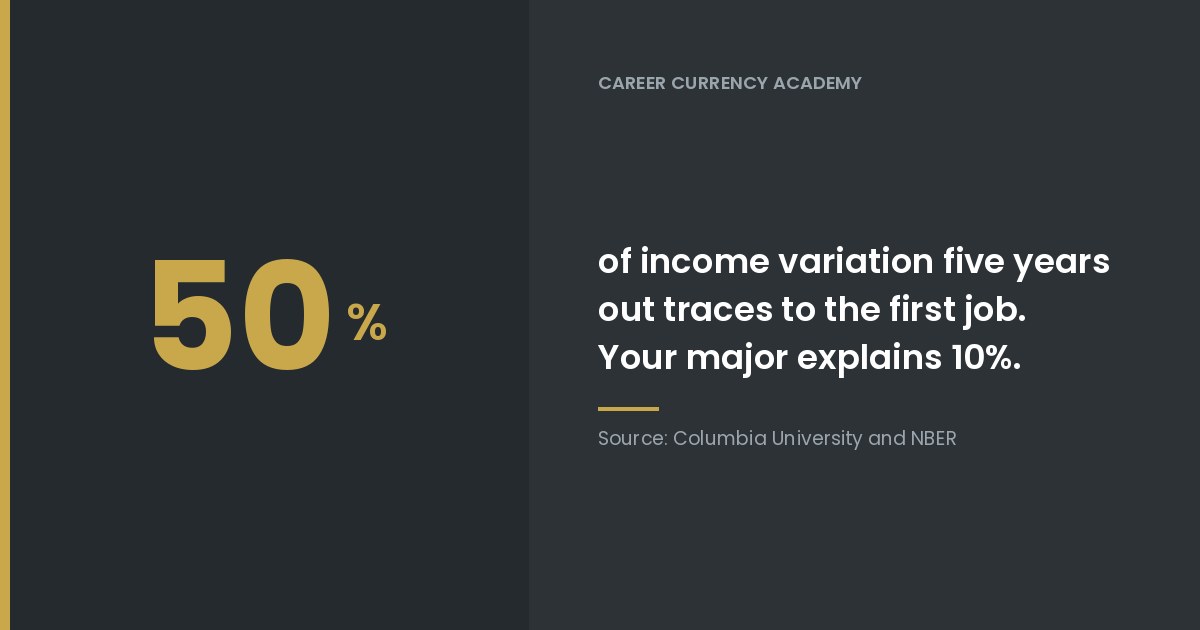
First job earnings alone accounted for nearly half the variation in income five years after graduation. Industry choice explained about 11%. Choice of major explained about 10%.
Sit with that ordering for a second. Parents spend enormous energy on the major decision. The data says the first job decision is roughly five times more consequential.
The study also found that graduates who landed a solid job before or soon after graduation, and stayed at least two years, earned meaningfully more later.
So the practical advice runs opposite to what most families do.
We treat senior spring as the moment the job search starts. The research suggests the first job should be planned like a major decision, starting junior year, with the same seriousness we apply to choosing a college.
It is not just about salary. It is about landing somewhere with a real employer, real training, and real people who will still know your student’s name in five years.
Take the first job seriously. It compounds.
Career Currency Academy treats the first job as a four-year project, not a senior spring scramble.
See the Full System