The Friendship Statistic Every Parent Should Know
Harvard economist Raj Chetty and the Opportunity Insights team analyzed 21 billion Facebook friendships covering most American adults. They were looking for what actually predicts whether a kid from a low-income family ends up better off.
It was not school quality. It was not family structure. It was not income inequality in the area. It was who their kids were friends with.
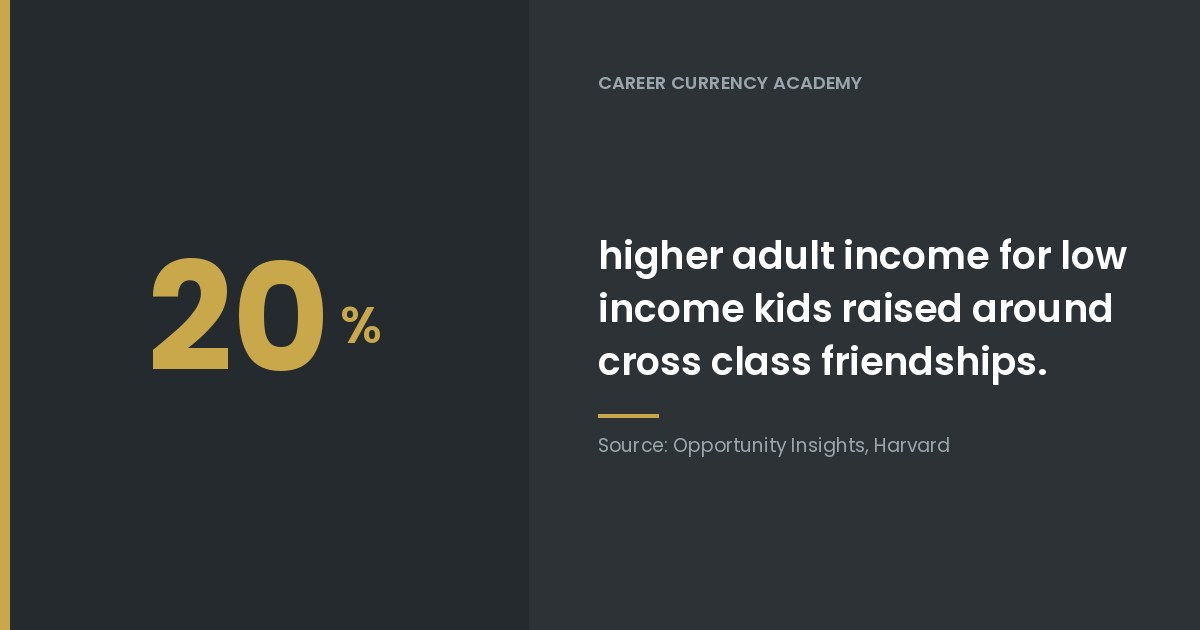
Children from low-income families who grew up in communities with high economic connectedness, meaning lots of friendships across class lines, earned about 20% more as adults. The researchers compared that effect to roughly two extra years of college.
Then there is the number that explains everything else. Fewer than 2% of the friends of people in the bottom 10% of income come from the top 10%. For people in the top 10%, 34% of their friends come from the top 10%.
Networks are not slightly sorted by class. They are almost completely sorted by class.
Here is why this belongs in a conversation about your student’s career and not just in a policy journal.
Everything families invest in, the tutoring, the test prep, the college fund, is aimed at the credential. This research says a meaningful share of the outcome is decided by something we never plan for at all: who your student ends up in a room with, and whether they know what to do once they are there.
College is the single best network mixing opportunity most people ever get. Most students spend it with people exactly like them.
Do not let that be an accident.
Career Currency Academy turns this research into a system students can run for four years.
See the Full System